
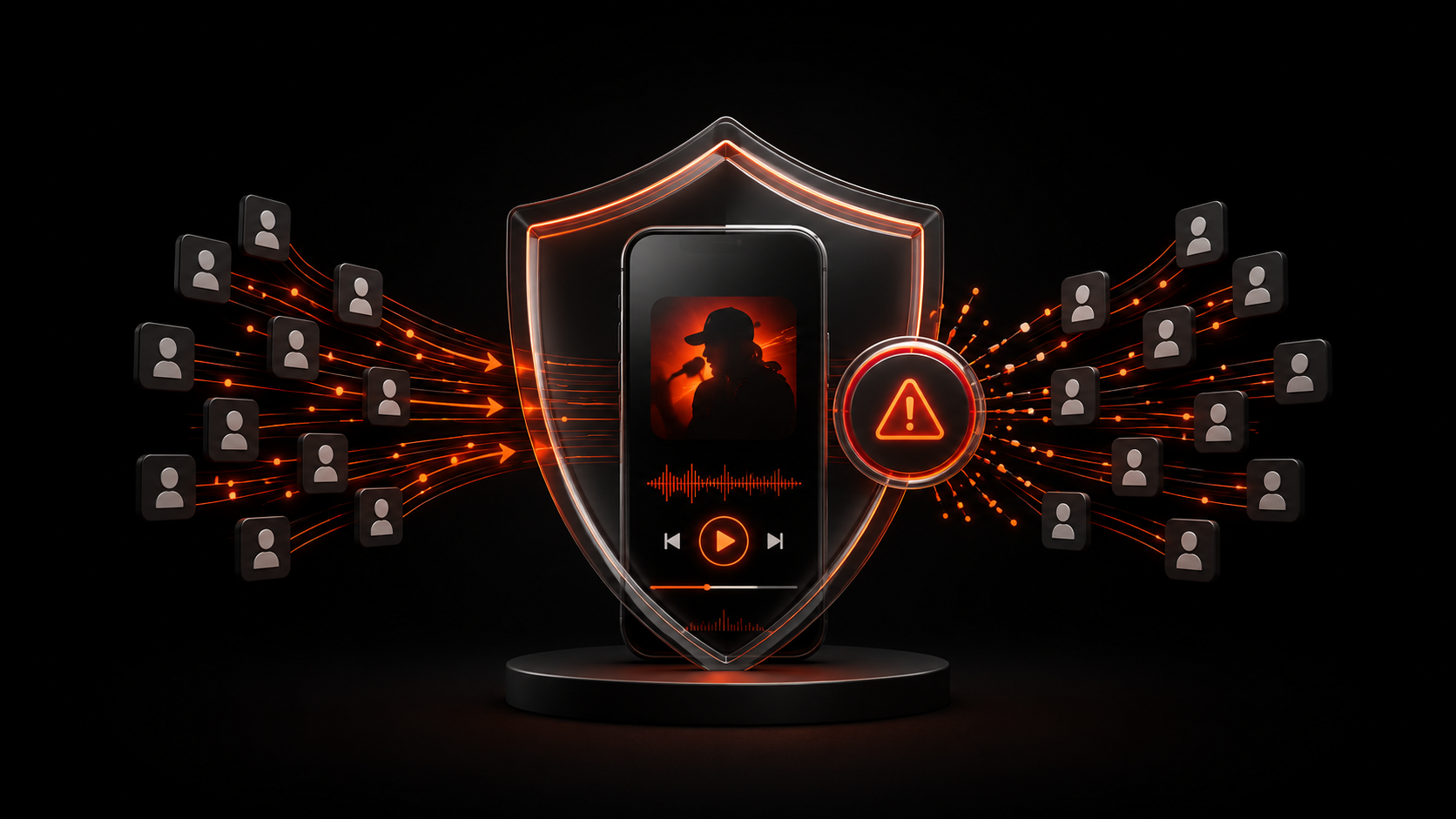
Quick Summary
Artificial streams are plays that do not represent genuine listening intent. They can be generated by bots, scripts, click farms, compromised accounts or other methods designed to manipulate streaming numbers. They may appear after an artist buys a guaranteed promotion package, but they can also affect a track without the artist's knowledge when it is added to a suspicious playlist.
Artificial activity is not harmless exposure. Spotify states that confirmed artificial streams do not earn royalties, do not count toward public stream totals or charts and do not positively influence its recommendation algorithms. Depending on the severity, a track can be removed from playlists or from Spotify, while a distributor may issue a warning, charge a penalty, suspend an account or remove content.
If you notice an unexplained spike, document it immediately, stop any questionable campaign, contact your label or distributor and report the suspicious playlist to Spotify. Do not wait for the numbers to disappear, and do not assume that visible streams must be legitimate simply because they appear in Spotify for Artists.
What Are Artificial Streams?
Spotify defines an artificial stream as a stream that does not reflect genuine user listening intent. This includes attempts to manipulate a streaming service through automated processes such as bots or scripts.
The essential distinction is intent. A real listener chooses to play a track because they want to hear it. Artificial activity is generated primarily to inflate a number, trigger a payment, create false popularity or make a promotional service appear effective.
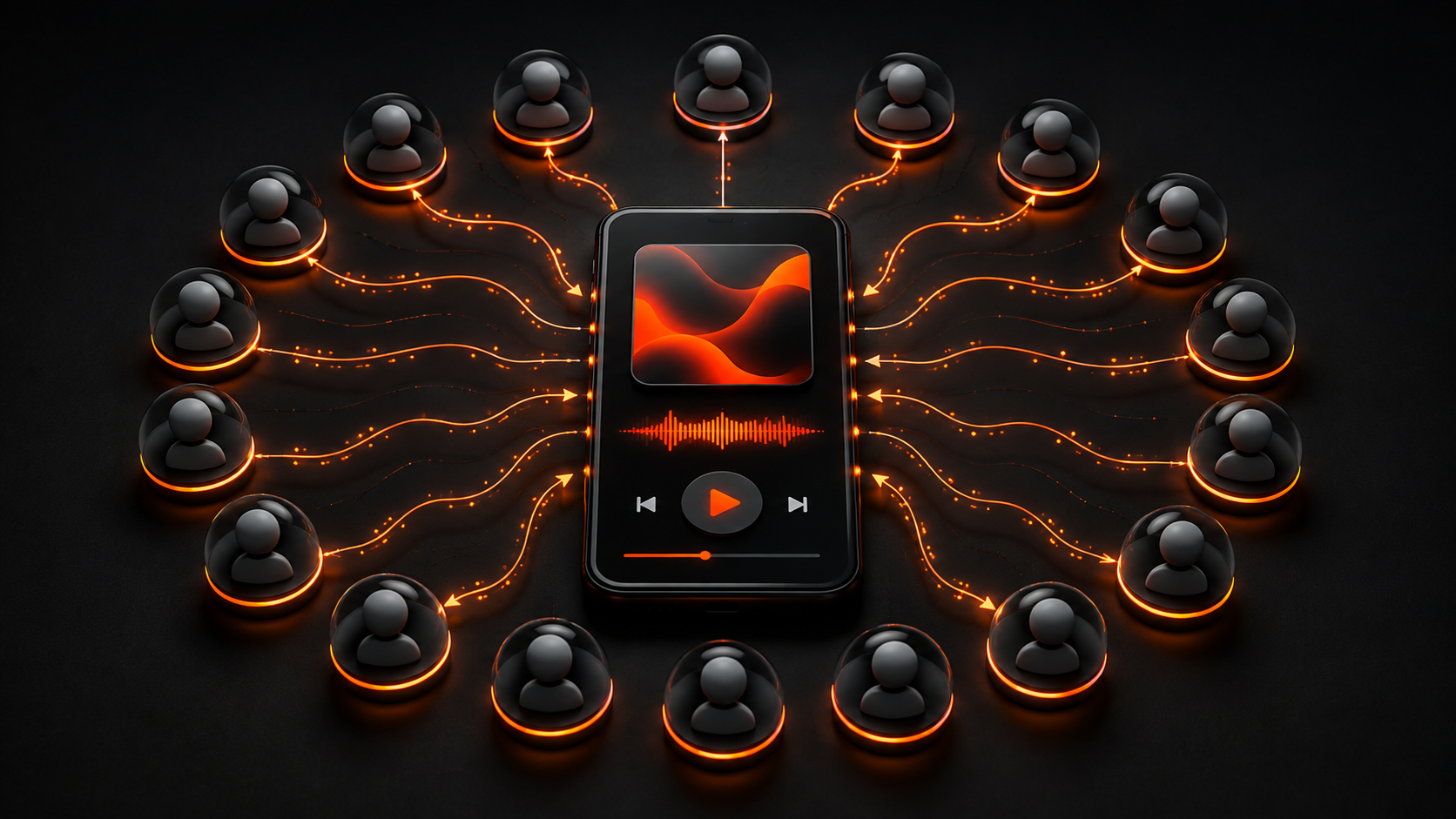
Artificial streaming can involve:
- bots repeatedly playing tracks,
- scripts controlling large numbers of accounts,
- click farms or device farms,
- compromised listener accounts,
- networks of fraudulent playlists,
- paid packages that guarantee streams or followers,
coordinated activity designed to manipulate charts or recommendations.
Not every sudden increase is fraudulent. A viral video, DJ support, a legitimate playlist addition, radio exposure, advertising or a new audience discovering an older track can all produce rapid growth. The goal is not to panic whenever a number rises. The goal is to determine whether the activity has a credible source and whether real listener behavior supports it.
Why Artificial Streams Can Harm an Artist
The promise behind fake promotion is usually simple: bigger numbers will make an artist look successful and encourage Spotify's algorithm to recommend the track. In reality, Spotify explicitly says that confirmed artificial streams provide none of those benefits.
They Do Not Generate Royalties
Confirmed artificial streams are excluded from royalties. A spike visible in Spotify for Artists is therefore not proof that the same activity will appear as payable revenue. Spotify may detect and remove streams before they reach the dashboard, or the spike may remain temporarily visible in private analytics while associated royalties are withheld and public numbers are adjusted.
For revenue, the statement supplied by your label or distributor is the more reliable source of truth.
They Do Not Help the Algorithm
Artificial streams do not positively influence Spotify's recommendation systems. Buying plays is not a shortcut into Discover Weekly, Radio, Release Radar or editorial playlists.
More importantly, fake activity gives the artist bad information. A producer may believe a country, campaign or track is performing well and spend the next marketing budget based on data that does not represent real fans.
They Can Trigger Penalties
Depending on the severity of the activity, possible consequences include:
- withholding of royalties connected to the artificial streams,
- correction of public stream counts and chart data,
- removal of a track from Spotify playlists,
- warnings or penalty fees from a distributor,
- suspension of a distribution account,
- takedown of a release,
removal of manipulated content from Spotify in repeated or serious cases.
Spotify also sends labels and distributors monthly reports about confirmed artificial streaming. Since April 1, 2024, Spotify has charged labels and distributors per track when it detects very high rates of artificial streaming. This creates a strong reason for distributors to act when the same artist or account repeatedly causes problems.
They Can Damage Your Decisions and Relationships
Even before a formal penalty, artificial activity can waste marketing money and reduce trust between the artist, manager, label and distributor. It can make campaign reporting unreliable, complicate royalty accounting and force a team to spend time proving how a release was promoted.
A real audience produces more than one impressive number. Real listeners save songs, follow artists, return to the catalog, share tracks, buy tickets, watch videos and respond to future releases. Bots do not build a career.
How Artists Get Exposed to Artificial Streaming
Some artists deliberately buy fake streams. Many others encounter them because they did not properly investigate a marketing offer or because a third party added their music to a suspicious playlist without permission.
Guaranteed Promotion Packages
The most obvious risk is a service that sells a fixed result: 10,000 streams, 2,000 followers, guaranteed playlist placement or guaranteed algorithmic growth. Spotify states that services promising streams or playlist placement in exchange for money violate its rules.
A professional marketer can sell work, advertising, strategy, content production, PR outreach or curator research. They cannot legitimately guarantee how many people will stream a song or promise a Spotify editorial placement.
Pay-for-Placement Playlists
Some curators ask artists to pay directly for a playlist position. Others use softer language such as an “activation fee,” “campaign slot” or guaranteed premium placement. Changing the wording does not remove the risk when the payment buys the placement or a fixed number of streams.
Spotify also advises artists to be highly skeptical of services that charge only to be considered for user playlists. Before paying any submission platform, understand exactly what the fee covers, how curators are selected and whether placement remains an independent editorial decision.
Poorly Controlled Marketing Agencies
An agency may describe its campaign as organic while outsourcing delivery to unknown playlist networks. If it refuses to identify its promotional methods, cannot explain where listeners will come from or reports only raw stream numbers, the artist has no way to evaluate the risk.
The person who accepts your payment does not need to operate the bots personally for your release to be affected.
Unsolicited Playlist Additions
Artists do not control every user-generated playlist. A track can be added to a fraudulent playlist without the artist's request or knowledge. Spotify acknowledges that this can happen and advises artists who notice abnormal data to contact their label or distributor immediately and report the suspicious playlist.
This is why regular monitoring matters even when you have never paid for playlist promotion.
Seven Warning Signs in Spotify for Artists
One signal alone does not prove fraud. Several unexplained signals appearing together should trigger an investigation.
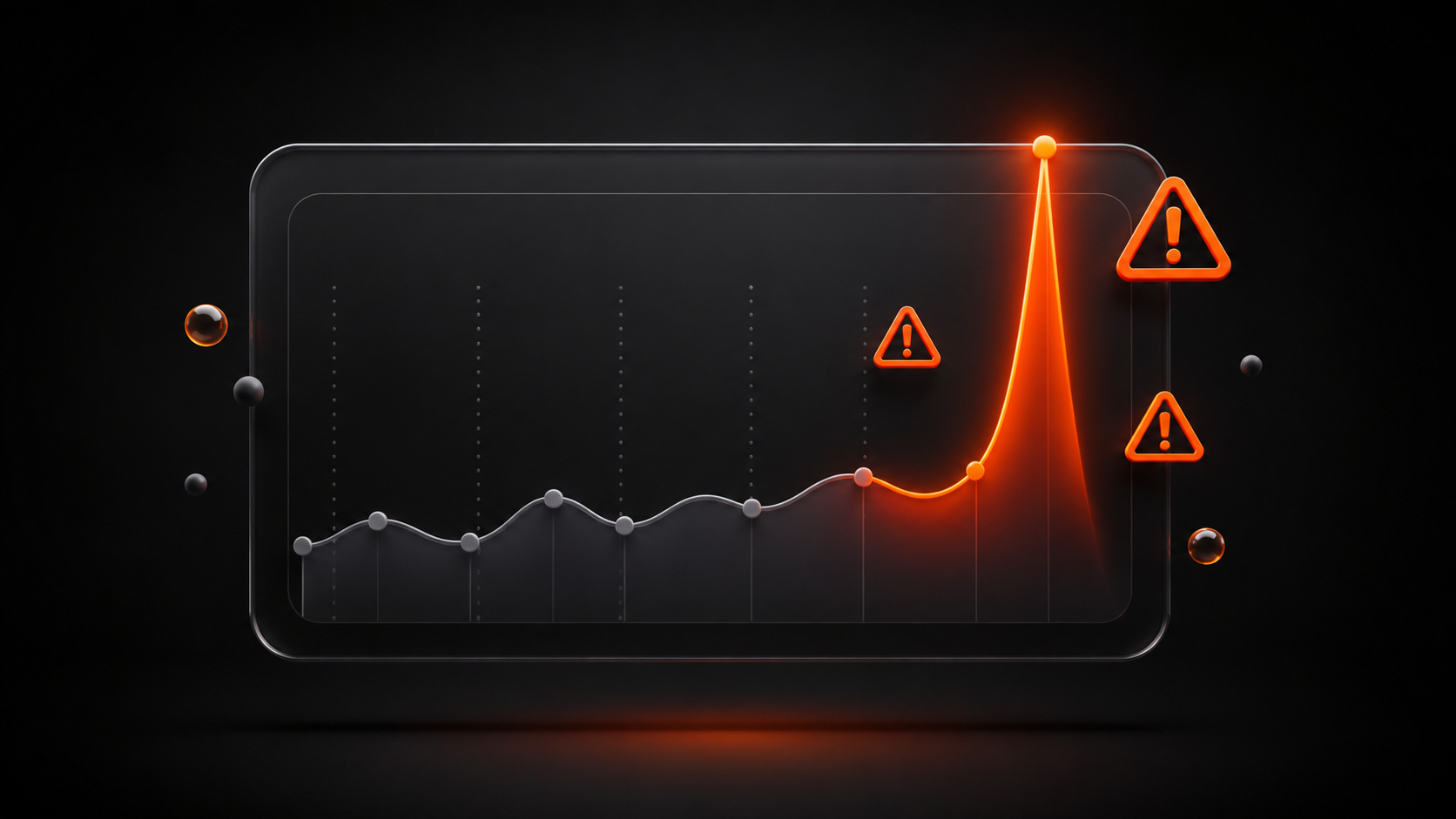
1. A Sudden Spike Followed by an Immediate Drop
The track receives a dramatic increase for one or two days and then returns to its previous level without a corresponding campaign, video, event, radio play or legitimate playlist addition.
2. Streams Arrive from an Unexpected Location
Thousands of plays appear from a city or country where the artist has no fan base, campaign, media coverage, tour activity or meaningful social engagement.
3. The Source of Streams Does Not Make Sense
Most of the new activity appears under an unexplained source such as Other, or comes from a playlist that does not match the track's genre, audience or scale.
4. Follower Growth Is Large but Short-Lived
The artist suddenly gains followers and then quickly loses them, while saves, profile visits, social engagement and catalog listening remain flat.
5. The Playlist Has No Clear Identity
The playlist mixes unrelated genres, changes large parts of its track list frequently, has a generic title or artwork, and provides no credible information about its curator or audience.
For a hardstyle release, a playlist jumping randomly between rawstyle, acoustic pop, trap, country and ambient music is not broad discovery. It is a serious warning sign.
6. The Numbers Do Not Produce Fan Behavior
A track gains thousands of streams but almost no saves, followers, personal playlist additions, repeat listeners, social reactions or plays on the artist's other releases. No single engagement ratio proves fraud, but a large disconnect deserves attention.
7. A Promoter Avoids Specific Questions
The company guarantees results but will not explain its channels, targeting, reporting, playlist selection or subcontractors. It sends screenshots instead of transparent campaign data and pressures the artist to renew before the first campaign can be evaluated.
What to Do in the First 24 Hours
If you discover suspicious activity, act quickly and calmly. Your objective is to preserve evidence, stop any controllable source and create a written record showing how you responded.
Step 1: Capture the Evidence
Record the situation before data changes. Save:
- screenshots from Spotify for Artists,
- the dates and approximate time the spike began,
- the track title, ISRC and Spotify track URL,
- the suspicious playlist URL and curator name,
- the countries, cities and sources of streams involved,
- the number of streams, listeners and followers before and after the spike,
- invoices, emails, messages and campaign agreements with every promoter,
- a list of all legitimate marketing running at the same time.
Do not edit screenshots in a way that removes dates, labels or useful context.
Step 2: Pause Questionable Campaigns
If a paid service may be responsible, request that the campaign be stopped immediately. Do not buy another package to “balance” the traffic, and do not accept a replacement playlist as a solution.
Keep the conversation in writing. Ask the provider to explain the traffic sources, playlists, advertising channels and subcontractors used for your release.
Step 3: Contact Your Label or Distributor
Spotify directs artists to their label or distributor because these partners receive platform reports and can work with Spotify on the case. Send a concise factual report rather than a general message saying that the numbers look strange.
Message Template for a Distributor or Label
Subject: Urgent: suspected artificial streaming on [Artist – Track]
Hello,
We noticed unusual Spotify activity affecting “[Track]” by [Artist], ISRC [ISRC], beginning on [date and time]. The activity includes [brief description: sudden spike, unexpected location, suspicious source or playlist].Suspicious playlist: [playlist name and URL]
Spotify track URL: [URL]
Approximate affected data: [streams/listeners/location/source][We did not authorize or pay for this playlist placement.] / [We hired the following promotional service and have asked it to stop the campaign: name, website and contact.]
We have attached screenshots, campaign records and a timeline of the activity. Please record this report on our account and advise whether any additional information is needed for your review with Spotify.
Best,
[Artist / manager / label]
Use the sentence that accurately describes your situation. Transparency is more useful than trying to hide a marketing decision after the data has already been flagged.
Step 4: Report the Suspicious Playlist to Spotify
Spotify for Artists provides a dedicated form for reporting suspicious playlists that have added your music. Include the playlist URL, affected track and the evidence you collected. The form may require you to sign in to Spotify for Artists.
Reporting a playlist does not mean Spotify will automatically classify every stream as artificial. It gives the platform information to investigate the activity.
Step 5: Continue Monitoring
Check the track daily for at least the next one to two weeks. Note whether the playlist removes the song, the traffic stops, the source changes or a second suspicious playlist appears. Update your distributor if the activity continues or spreads to other releases.
Do not publicly accuse a curator or promoter of fraud unless you have reliable evidence. Report the facts through the appropriate channels first.
How to Vet a Music Promotion Service Before Paying
Legitimate music marketing costs money. The difference is that a legitimate provider sells a transparent process, not a guaranteed streaming outcome.
Before hiring a PR company, playlist submission service or marketing agency, ask:
- What exactly am I paying for?
The answer should describe the work: advertising, content, outreach, pitching, campaign management or reporting. - Do you guarantee streams, followers or placements?
Any guaranteed platform result is a reason to walk away. - Which channels will generate the audience?
Ask whether the campaign uses Meta Ads, TikTok Ads, YouTube Ads, press, influencers, creator content, email, radio or curator outreach. - Will I see the campaign data?
For advertising, request evidence of targeting, spend and results. For outreach, request a description of the curator selection and submission process. - Do you use subcontractors or playlist networks?
Your provider should remain responsible for the methods used on your release. - Can placement be declined?
Real editorial pitching does not guarantee acceptance. A curator must be free to reject a track. - What happens if suspicious activity appears?
The contract should allow the campaign to be stopped and require the provider to cooperate with an investigation.
Search for independent reviews, speak to artists who used the service and examine more than its best screenshot. A case study showing a large stream count is not enough. Look for evidence that the campaign reached a relevant audience and created lasting engagement.
Build a Safer Promotion Strategy
The strongest protection is a release plan in which every source of attention can be explained.
Use Traceable Channels
Prioritize campaigns you can monitor: artist and label social channels, direct fan communication, transparent advertising accounts, credible press, DJ support, creator partnerships and targeted curator outreach.
Keep a Campaign Log
For every release, maintain a simple record of:
- campaign provider,
- start and end date,
- budget,
- destination link,
- audience and countries targeted,
- expected promotional method,
- playlist or media contacts,
- weekly results.
If a suspicious spike appears, this log makes it much easier to identify what changed.
Limit Account Access
Marketing companies rarely need full administrator access to Spotify for Artists. Give each collaborator only the access required for their role, review team members regularly and remove access when the work ends. Never share personal passwords when an official team invitation or advertising-account role is available.
Evaluate Quality, Not Only Volume
Useful campaign signals include saves, artist follows, repeat listening, catalog discovery, relevant territories, video engagement, mailing-list growth and ticket or merchandise interest. A smaller campaign reaching real hard-dance listeners is worth more than a large burst of anonymous traffic.
Review Your Data Regularly
Do not wait for a distributor warning. Check Spotify for Artists during every active campaign and after every playlist addition. Establishing a normal baseline for your streams, listeners, sources and territories makes unusual activity easier to recognize.
What Legitimate Growth Usually Looks Like
Organic growth is not always slow, and fraudulent growth is not always large. However, legitimate activity usually has a story that can be followed across several signals.
A hardstyle track supported by a real festival clip may show more video views, profile visits, streams, saves and follows from relevant countries. A legitimate genre playlist may introduce listeners who continue to the artist's other tracks. A targeted advertising campaign should correspond with the countries, dates and audience selected in the ad platform.
The data does not need to be perfectly balanced. It needs to be credible. You should be able to answer: Why did these listeners arrive, where did they come from and what did they do next?
FAQ: Artificial Streams on Spotify
Can my track receive artificial streams without my permission?
Yes. Spotify acknowledges that bots can drive artificial streams without an artist's knowledge or consent. If you notice abnormal activity, document it, contact your label or distributor immediately and report the suspicious playlist to Spotify.
Will Spotify punish me for an unsolicited fake playlist addition?
Spotify investigates the activity, and an unsolicited addition does not automatically prove that the artist purchased streams. However, you should not ignore it. A prompt written report and complete evidence help your label, distributor and Spotify review what happened.
If the streams appear in Spotify for Artists, are they legitimate?
Not necessarily. Artificial activity may still appear temporarily in private Spotify for Artists data even when royalties are withheld and public metrics are adjusted. In other cases, Spotify may remove it before it reaches the dashboard.
Do artificial streams generate royalties?
No. Spotify states that confirmed artificial streams do not earn royalties. Your label or distributor's royalty statement is the best source for payable revenue.
Can fake streams help my track enter algorithmic playlists?
No. Spotify states that artificial streams do not positively influence its recommendation algorithms. No third-party service can legitimately guarantee algorithmic or editorial placement.
Is all paid music promotion prohibited?
No. Artists can pay for legitimate advertising, PR, content creation, campaign strategy and outreach. The risk begins when a service sells guaranteed streams, followers, playlist placement or another manipulated platform result.
Should I ask Spotify to remove my track immediately?
Usually, your first step should be to document the activity and contact your label or distributor, not request a takedown on your own. They can review the situation and advise on the correct action. If the music was removed unexpectedly, Spotify also directs artists to their label or distributor for details.
How often should I check Spotify for Artists?
During a release campaign, review it regularly enough to recognize a change quickly—ideally daily around release day and while paid promotion is active. For older catalog tracks, a weekly review or automated distributor alert may be sufficient, depending on your release volume.
Conclusion
Artificial streams do not create fans, royalties or sustainable discovery. They create false data and expose the artist, label and distributor to unnecessary risk.
Protecting your music does not require treating every playlist as suspicious. It requires knowing who promotes your release, understanding how they work, monitoring your data and responding quickly when the numbers no longer make sense.
The safest growth strategy is also the most valuable one: release strong music, reach a relevant audience through transparent channels and give real listeners a reason to return.
Would You Like to Release Your Music with The MasterBeat Project?
The MasterBeat Project focuses on hardstyle and hard-dance releases. The MasterBeat Horizon is dedicated to selected EDM projects and related electronic genres. Send us your demo together with basic information about the track and artist through the Demo Submission section of our website.

The MasterBeat Project - Powerful music. Real artist development. No shortcuts.
Sources and further information:
Spotify for Artists – Artificial streaming
Spotify for Artists – Artificial streaming and paid third-party services
Spotify for Artists – Royalties Guide
Spotify for Artists – Report a suspicious playlist
Symphonic – Trust & Safety and StreamSafe
Symphonic – How to Detect Fake Spotify Playlists